 GlimmerGirl Games
GlimmerGirl Games
GlimmerGirl Games
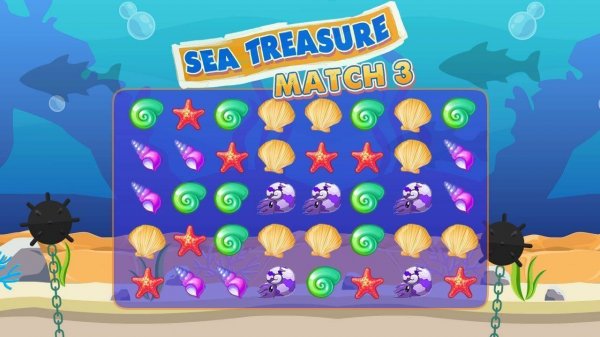
Coral Reef Tile Swap Puzzle delivers exactly what its name promises: a no-fuss matching game set in an underwater world. The level design starts simple and slowly introduces new obstacles, keeping the challenge steady without becoming frustrating. Visuals are bright and cheerful, and the audio creates a peaceful backdrop. Controls work well on both desktop and mobile. While it does not reinvent the genre, it executes the formula cleanly and offers a pleasant way to pass a few minutes.
Players interact with a grid filled with various sea-themed icons such as star-shaped tokens, shell motifs, and pearl-like circles. The primary action involves selecting two adjacent tiles to swap their positions. When three or more identical icons align in a row or column, they vanish from the board, allowing new tiles to fall into place. This chain reaction can clear multiple groups at once, rewarding thoughtful placement.
Each stage presents a distinct goal. Some levels require collecting a set number of a specific icon, like removing twenty star tokens. Others ask players to reach a certain score within a limited number of moves. The game gradually introduces new conditions, such as obstacles that block tile movement or special tiles that must be cleared first. This variety keeps the experience fresh without overwhelming new players.
The art style uses bright, saturated colors with soft gradients, giving the underwater theme a friendly and approachable look. Icons are clearly distinguishable, making it easy to spot matching groups at a glance. Background music consists of calm, looping melodies reminiscent of gentle ocean waves. Sound effects for swaps and matches are subtle and non-intrusive, contributing to a relaxed atmosphere.
Early levels serve as a tutorial, guiding players through basic mechanics with simple tasks. As players advance, the puzzles require more strategic thinking. The number of moves per level decreases, and the board layouts become more complex. This gradual increase in difficulty ensures that players build their pattern recognition skills over time. There is no penalty for failing a level, encouraging experimentation.
The interface is designed for both desktop and mobile play. On a computer, players click tiles with a mouse. On touchscreens, they tap and drag to swap. The controls are responsive and require minimal precision, making the game suitable for younger audiences or those with limited dexterity. Menus are clearly labeled, and level selection is presented in a linear map format.





Comments
Sign in to comment
You must be logged in before posting a review or rating.
No account? Create one
No comments yet. Be the first to comment!