 GlimmerGirl Games
GlimmerGirl Games
GlimmerGirl Games
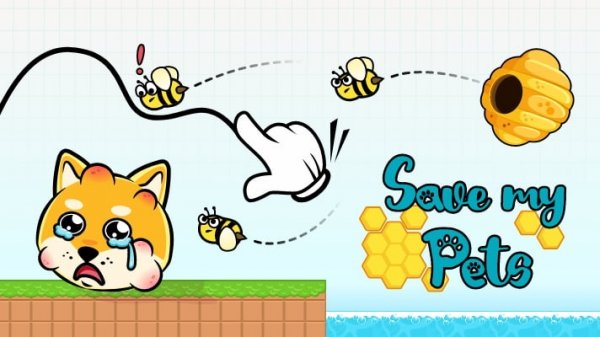
Canine Shield Logic Puzzle stands out for its simple yet flexible drawing mechanic. The lack of time pressure makes it ideal for relaxed play, while the increasing level complexity keeps the mind engaged. The cheerful art style and gentle audio create a welcoming atmosphere for all ages. It is a well-crafted puzzle game that respects the player's time and creativity.
Instead of tapping or swiping, this game uses freehand drawing as its primary mechanic. Players hold down a mouse button or finger to trace a line across the screen. That line becomes a solid wall. The shape and placement of that wall are entirely up to the player. This turns each stage into a small design problem. You are not just solving a puzzle; you are constructing a solution from scratch. The openness of the drawing tool means there is rarely one correct answer. A curved barrier might work as well as a straight one, depending on the layout.
Bees emerge from a fixed hive location and follow a direct path toward the dog. Their movement is predictable, which allows players to plan ahead. The wall must remain intact for a set duration after the bees begin their approach. If the barrier holds, the level is cleared. This introduces a gentle timing element. Players must ensure their line is complete before the insects reach their target. The bees do not speed up or change direction, so the challenge comes from spatial planning rather than quick reflexes.
The game presents a bright, cheerful world with hand-drawn animal characters. Dogs have expressive faces and wagging tails. Bees are cartoonish and non-threatening. The background colors are soft and varied, changing from level to level. There are no dark themes or intense sound effects. The audio is limited to light, pleasant tones that mark successful barrier placement and level completion. This creates a calm environment where players can focus on the logic without distraction.
Early stages introduce the basic mechanic with simple layouts. The dog and hive are positioned in a straight line, requiring a single wall. Later levels add obstacles like rocks or trees that force players to draw around them. Some stages place the hive at an angle, requiring barriers that cover multiple approach paths. The difficulty increases gradually, ensuring that new concepts are introduced one at a time. This structure keeps the game accessible for younger players while still offering enough complexity for adults.
Because the drawing tool is flexible, players can experiment with different barrier shapes. A tall thin wall might block a direct path but leave gaps on the sides. A wide low wall might cover more ground but be harder to draw in a single stroke. The game rewards creative thinking. If a particular approach fails, trying a completely different shape often leads to success. This trial-and-error process is central to the experience. There is no penalty for mistakes, so players are free to explore unusual solutions.




Comments
Sign in to comment
You must be logged in before posting a review or rating.
No account? Create one
No comments yet. Be the first to comment!